Self Defence in Taekwon-Do
Self defence is not a module bolted onto Taekwon-Do; it is the reason Taekwon-Do exists. General Choi Hong Hi developed the art with the explicit goal of giving ordinary people the ability to protect themselves and those around them. Every technique we train, every pattern we practise, every step-sparring drill we repeat has its roots in a practical application. Understanding that connection is what separates a martial artist from someone who simply exercises in a uniform.
Awareness and Avoidance
The most effective self defence technique is the one you never have to use. We teach students to read their environment, recognise warning signs, and make smart decisions that remove them from danger before it escalates. This is the first and most important layer of the self defence syllabus, and it applies regardless of your age, size, or fitness level.
The Foundation of Every Technique
When you learn a block, you are not just learning to stop a punch; you are learning to redirect force, create distance, and set up a counter-attack. When you practise a pattern, every movement in that pattern corresponds to a defence against a real attack. This is why we study patterns seriously rather than treating them as a choreography exercise. The pattern is a library of responses, and the deeper you go, the richer that library becomes.
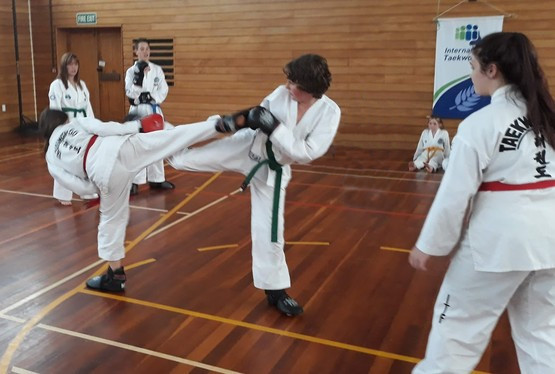
Step sparring reinforces this directly: a predetermined attack is met with a precise sequence of blocks, counter-attacks, and takedowns, repeated until it becomes reflex. In a real confrontation, conscious thought is too slow. Your body needs to know what to do before your mind catches up.
Releases and Counters
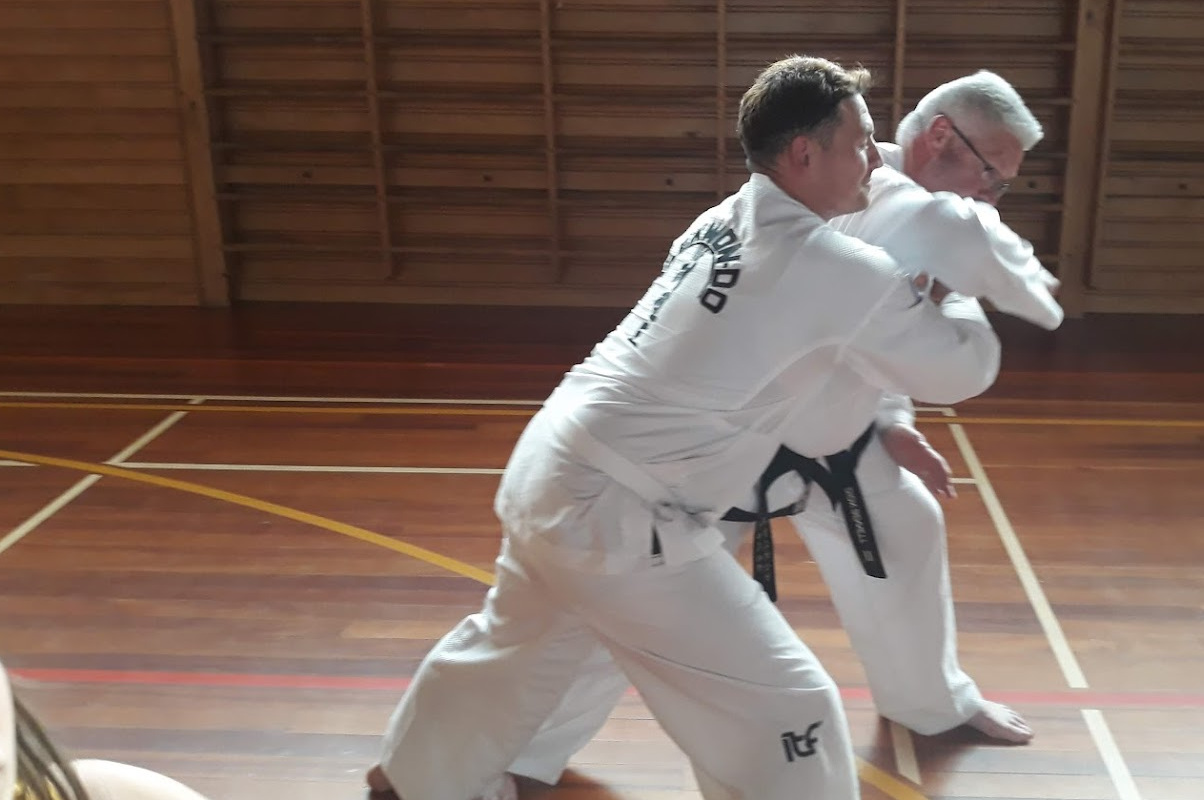
A large part of our self defence syllabus deals with situations where someone has already grabbed you: a wrist grab, a lapel grab, a bear hug, a headlock. We teach systematic releases that work by exploiting the mechanical weaknesses of the human grip and body rather than relying on brute strength. This means they work for a smaller person against a larger attacker, which is exactly when self defence matters most.
Once a release is made, the syllabus covers the follow-up: creating distance, controlling the threat, and finishing if necessary. These are practised carefully in class with respect for training partners.
Ground Defence
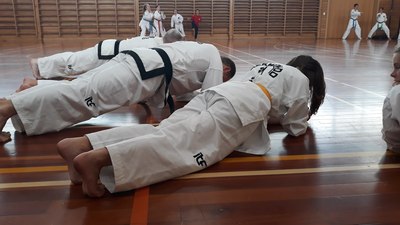
Many real confrontations end up on the ground. Our syllabus includes techniques for situations where you have been taken down or are pinned, covering escapes, reversals, and how to regain a standing position safely. The prone hold is a particularly practical sequence that forms part of our grading syllabus at intermediate levels.
Your Rights Under New Zealand Law
Knowing how to defend yourself is only half the picture. We ensure all students understand what the law says about the use of force in self defence in New Zealand. Section 48 of the Crimes Act 1961 permits reasonable force to defend yourself or another person, but "reasonable" is a word that matters enormously. We discuss what this means in practice so that students can act with both confidence and responsibility.
Self Defence for Kids
The self defence syllabus starts in our mini-kids class. Age-appropriate techniques focus on breaking free from grabs, creating distance, and using a loud voice as a deterrent. Equally important is the confidence that comes from knowing you have options. Children who train in Taekwon-Do carry themselves differently, and that alone is often enough to deter unwanted attention.
The Bigger Picture
Physical techniques are only one dimension of self defence. Taekwon-Do also builds the mental and emotional attributes that underpin them: composure under pressure, decisiveness, the ability to act rather than freeze. These qualities are developed gradually through consistent training, and they show up in all areas of life, not just in a confrontation. This is what General Choi meant when he described Taekwon-Do as a way of life, not merely a fighting system.
If you would like to see any of this for yourself, come along to a class. The first month is free.
Mosgiel Taekwon-Do
We are an ITF Taekwon-Do club in Mosgiel, New Zealand. We are led by Mr. Bob Brown, 2nd dan and we train on Monday and Wednesday evenings and have extra activities throughout the year. Membership is open to anyone over the age of six and your membership allows you to train with any other ITF club world-wide.
Not sure if Taekwon-Do is right for you? You can come along to the club and observe or try for free for one month, no strings attached. Find out more.
Contact Us
Mosgiel Taekwon-Doc/o The Taieri College,
Centennial Gymnasium,
Church Street Entrance,
Mosgiel Phone: 021 066 4660 (call or txt)
Email: enquiries.mosgieltkd@gmail.com
Why Taekwon-Do?
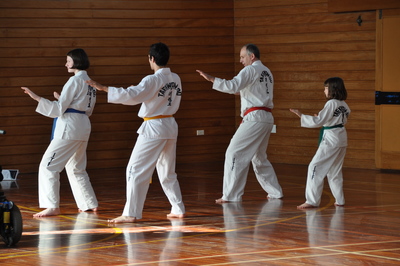
Taekwon-Do has many physical and mental health benefits, and promotes both personal achievement and working with others - see if it's right for you.
Self Defence
We teach self defence which is only effective if it becomes a reflex. We cover awareness, avoidance, releases, counter-attacks and your rights under NZ law.
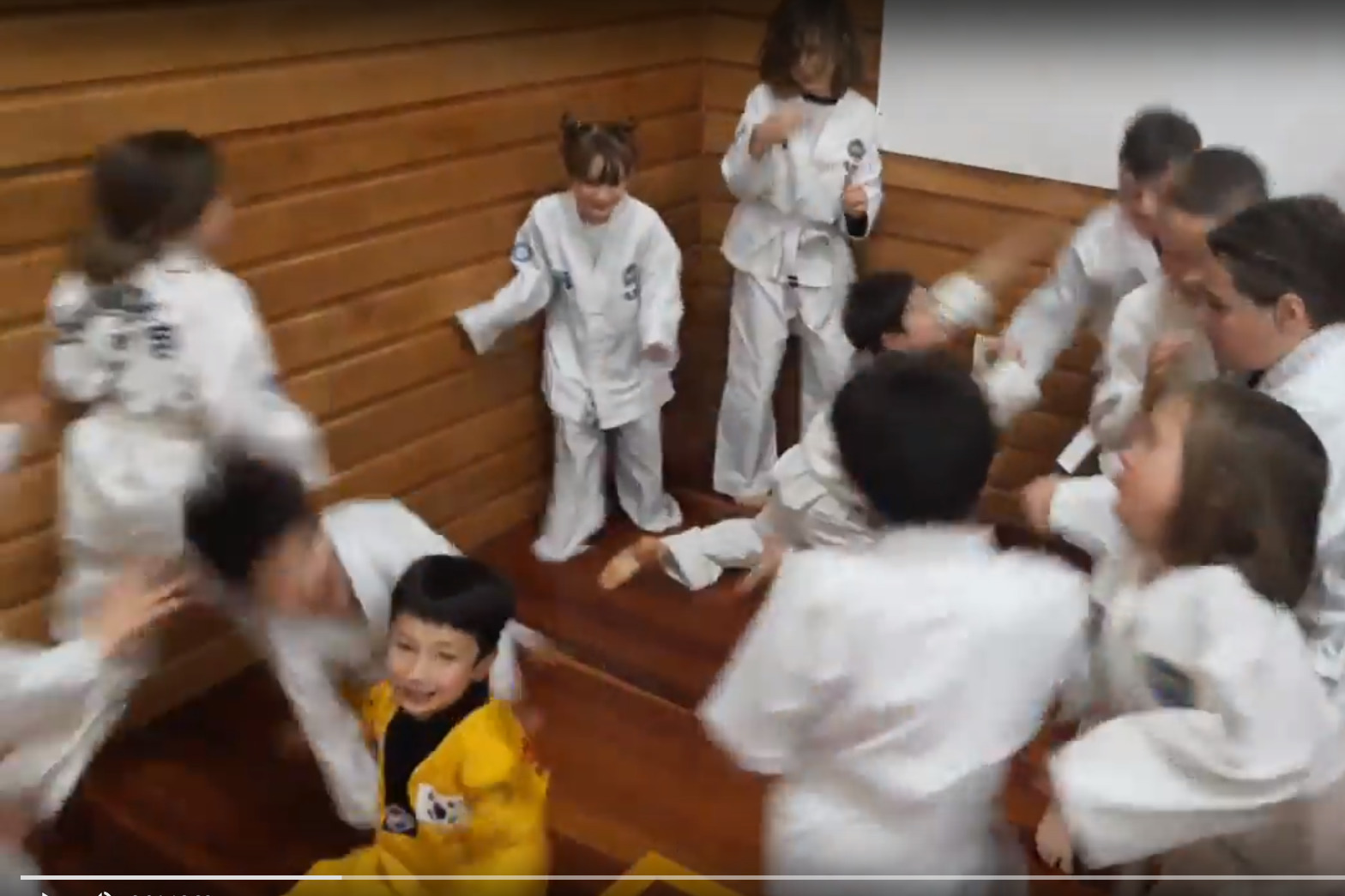
Check out our Mini-Kids class
Starting Taekwon-Do is the biggest hurdle, but not for our kids - we have a good group of kids who love to work and play together to learn about Taekwon-Do.